Nigerian Telecoms’ apex regulatory agency, Nigerian Communications Commission(NCC) has revealed the reasons why users of Android smart phones and tablets pay more for data in Nigeria. The commission says it is not turning a deaf ear to the lamentations of Nigerians noting that the differences in data allowance for Android and Blackberry users have been generating a lot of controversy among consumers of late. NCC via its official Facebook page stated that while BlackBerry indirectly subsidises bandwidth for its users by compressing the content downloaded, Android downloads and consumption was not compressed therefore leading to the expending of more bandwidth.
Via PUNCH reports: The regulatory agency says it is still committed to protecting Nigerians against unfair practices by telecoms service providers in the country. According to the NCC, Internet subscribers using BlackBerry smart phones pay far less than their counterparts making use of Android devices because BlackBerry Limited (Formerly Research in Motion) utilises a special algorithm to serve its users better. Writing on its Facebook page, the NCC argues that BlackBerry indirectly subsidises bandwidth for its users by compressing the content downloaded by subscribers. Unfortunately, the NCC adds, downloads and consumption was not compressed for Android phones. The result is that Internet surfing on such operating devices will require more bandwidth.
The NCC says, “The manufacturer of BlackBerry utilises a special compression algorithm to serve users of Blackberry handsets who have subscribed for the Blackberry Internet Service. Whenever such a subscriber browses the Internet and opens a webpage, a request is sent via the handset’s browser requesting for the page to be downloaded to the phone. “This request is channelled to BlackBerry Limited’s gateway in Canada, which fetches the webpage, compresses it and sends the compressed data back to the BlackBerry phone as a download. “On an Android phone, the request to open a webpage by telephone subscribers is sent to the gateway of the network operator, which then processes the information and sends back the page to the Android phone as a download. But the data is not compressed – thereby requiring more bandwidth.”
1st Class Tabs
Saturday, 7 June 2014
Friday, 4 April 2014
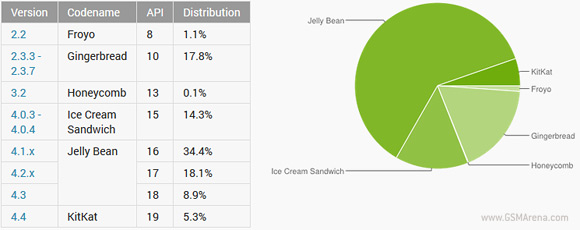
ANDROID IN MARCH: GOING FROM 4.2 JB STRAIGHT TO 4.4 KITKAT
Another month, another Android platform distribution update by Google. The big news is that in March this year Android 4.4 KitKat has crossed the 5% mark, while everything pre-4.1 declined.
Some vestigial Froyo devices still hang around at 1%, Gingerbread now holds under 20%, while Ice Cream Sandwich and 4.1 Jelly Bean declined.
Android 4.2 Jelly Bean rose a bit and is now well ahead of ICS. That's interesting because version 4.3 stayed in place since January, suggesting that makers are leapfrogging 4.3 and going straight to 4.4
With KitKat on the rise and Jelly Bean mostly staying in place, OpenGL ES 2.0 support actually declined a bit, while OpenGL ES 3.0 inched forward. This is important for game devs who might be considering using the more advanced graphics features - they can now reach 10.5% of all Androids.
Wednesday, 2 April 2014
NOKIA ANNOUNCES ANDROID RUNNING NOKIA X AND NOKIA X+
Nokia announced its first Android-app running smartphones - the Nokia X and Nokia X+. The phones pack a 4" LCD display and come with Nokia and Microsoft app preloaded.
The Nokia X, X+ and XL are powered by a 1GHz dual-core Qualcomm Snapdragon 8225 chipset with 512MB of RAM and 4GB of internal storage. Happily, it's expandable via the microSD card slot and supports up to 32GB cards.
The Nokia X and X+ feature a 4" 800x480 IPS LCD capacitive touch display making up for a pixel density of 233ppi. However, the Nokia X+ and XL get a bump in RAM to 768MB.
At the back of the Nokia X and X+, there's a 3MP fixed focus camera with both phones weighing 129 grams and pack 1500mAh battery. It's good for 10.5 hours of 3G talk time and have a maximum standby time of 17 days. Both phones are also capable of maximum music playback of up to 26 hours, while video playback is rated at 8.4 hours before the battery needs a recharge.
The Nokia X features the signature Nokia Glance Screen. A swipe to the right reveals a list of installed apps, and another one gets you to fastlane. You can reorganize the tiles similarly to Windows Phone 8 UI. They are resizable as well and the larger the tiles get, the more information they display.
Unsurprisingly, the phone doesn't have the Google Play Services installed, so the Play Store isn't available on the Nokia X or Nokia X+. However, Stephen Elop highlighted that users can take advantage of the Nokia store for Android apps as well as the popular Yandex Store.
Source | GsmArena
Tuesday, 25 March 2014
SAMSUNG TO LAUNCH GALAXY S5 ON MARCH 27
Samsung has confirmed that it will be holding an event in Delhi to launch the latest flagship Galaxy S5 in India. A company source told Tech2 that the launch event will take place on March 27, the coming Thursday, though it’s unlikely that the phone will go on sale that day.
What’s possible is that Samsung will kick-off pre-orders for the S5, along with some introductory discounts, and operator and services tie-ups specific to India. The company is already bundling in a bunch of apps with the phone. As was announced during the Samsung Unpacked 5 event last month, the company will start selling the phone from April 11, and
Saturday, 22 March 2014
WHITE HOUSE TESTING SAMSUNG AND LG PHONES
BlackBerry has been a byword for security. A statement which is testified by a number of United States Government agencies and administrations using it, including the White House. According to a report by the Wall Street Journal the troubled company might lose even that stronghold however as the White House is currently researching Samsung and LG smartphones for its employees to use
This is a major change for the White House, whose employees have been using BlackBerry OS for ages. The Wall Street Journal reports that the tests are in their early stages. A Department of Defense spokesman confirmed to the newspaper that the White House "is piloting and using a variety of mobile devices".
There are also rumors floating around that Apple's iOS has been dismissed from the testing plans altogether. That's President Barack Obama's choice for his personal smartphone, but it seems Apple's mobile OS hasn't been considered due to its some unspecified limitations.
If testing ends successfully then BlackBerry will be in even more unenviable position. Previously, the Pentagon denied rumors of it ordering 80,000 BlackBerry phones and with the latest development, there's an indication that administration will be joining consumers in rejecting the brand.
Seems everyone is moving on. What the heck? BBM was the only reason we joined the Blackberry bandwagon in the first place.
There are also rumors floating around that Apple's iOS has been dismissed from the testing plans altogether. That's President Barack Obama's choice for his personal smartphone, but it seems Apple's mobile OS hasn't been considered due to its some unspecified limitations.
If testing ends successfully then BlackBerry will be in even more unenviable position. Previously, the Pentagon denied rumors of it ordering 80,000 BlackBerry phones and with the latest development, there's an indication that administration will be joining consumers in rejecting the brand.
Seems everyone is moving on. What the heck? BBM was the only reason we joined the Blackberry bandwagon in the first place.
Labels:
Android,
Apple,
Apple Mobile OS,
BBM,
Blackberry,
BUSINESS,
design,
Iphone,
LG,
Mobile phones,
Samsung,
TECHNOLOGY
ANDROID 4.3 APPROVED FOR SONY Xperia M
We have some good news for the Sony Xperia M owners. Even though the company is
going to launch the Xperia M2 very soon, Sony hasn't forgotten its
predecessor.
Apparently Sony has been working on Android 4.3 Jelly Bean
firmware update and it will soon begin rolling out. The first country to get it
should be France as the SFR carrier has already approved the ROM recently.
Vodafone Australia has also shared it is testing the new firmware
on its Xperia M version and if everything goes without hiccups, the Android 4.3
Jelly Bean for the Australian Xperia M should be out soon too.
So, Sony seems to be finished developing the update and hopefully
it will reach all Xperia M units around the globe in the next couple of weeks.
According to the SFR changelog the new update will bring your Xperia M Android
4.3 Jelly Bean, faster UI, updated multimedia apps (Walkman, Album, Movies),
Xperia Themes and better bookmark management in Chrome.
There is no word if the Xperia M will be getting the KitKat
treatment later this year as its Xperia M2 successor.
Thank you, AblaZe, for the tip!
Subscribe to:
Posts (Atom)
.jpg)